
The Complete Guide to Montana Sapphires — Written From Montana
I live a few hours from every sapphire deposit in Montana. This is the guide I wished existed before I started building a brand around these stones.
What follows is the material as I understand it — geological, historical, commercial, and verifiable. Montana sapphires are receiving renewed national attention, and that makes the truth of the material more important, not less.
What Are Montana Sapphires?
Montana sapphires are corundum — the same mineral as every other natural sapphire — formed underground in this state and recovered from three principal deposits. They rank 9 on the Mohs hardness scale, second only to diamond among gemstones, which makes them suitable for daily wear across generations.
They are also the only precious gemstone commercially mined at meaningful scale in the United States, and Montana's official state gemstone, designated in 1969 alongside the Montana agate.
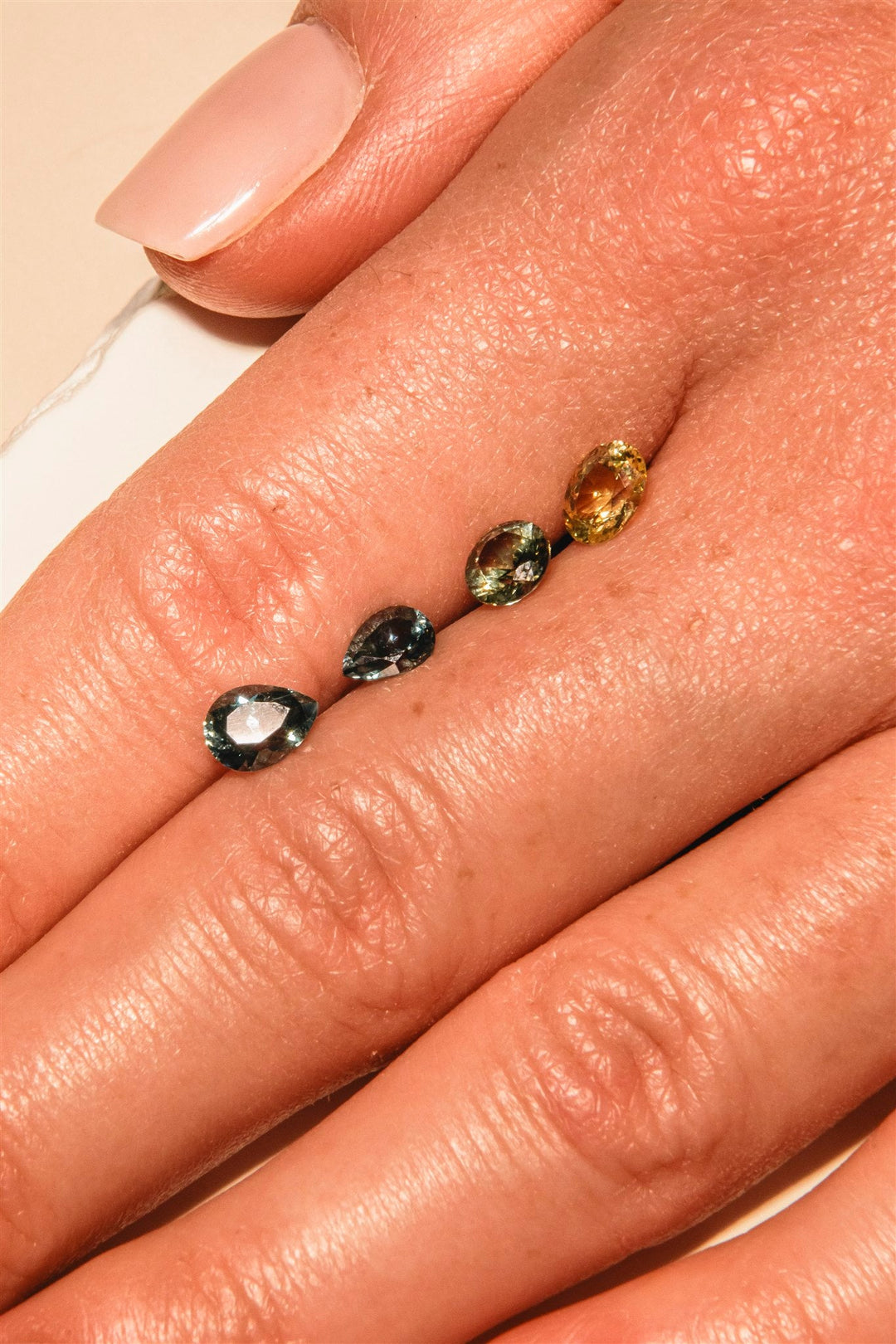
Color ranges far beyond the blue most people associate with sapphire: teal, sage and forest greens, denim and cornflower blues, golden yellows, peach, pink, and parti-colored stones holding two hues in a single crystal. Color comes from trace elements — iron and titanium — fixed when the crystal formed and never repeated exactly twice.
Where Montana Sapphires Come From
Montana produces sapphires from three principal areas. Each has its own geology and character, and any reputable seller should be able to tell you which one yours came from.
Rock Creek (near Philipsburg)
The largest and most productive deposit, and the source of most of the stones in our collection. Rock Creek is an alluvial deposit — sapphires weathered out of their parent rock over geologic time and settled into gravel benches above the creek. They are recovered by washing gravel through water-fed jigs and shaking tables, then hand-picked from the heavy concentrate.
Rock Creek produces the widest color range of any Montana deposit. The teals, sage greens, golden tones, and parti-colored stones associated with the modern Montana sapphire are nearly all from here.
Yogo Gulch (Little Belt Mountains)
The exceptional deposit — a narrow dike of igneous rock running for miles through the surrounding limestone, with sapphires still embedded in the host rock that produced them. Yogo is hard-rock mining: tunnels, ore, and slow extraction. It has resisted industrial-scale operation for more than a century.
Yogo sapphires are uniformly cornflower blue, naturally untreated, and almost always under one carat. The crystals form thin and flat, which makes any clean stone above a carat genuinely rare. Yogos command a premium for two reasons: the natural color requires no treatment of any kind, and the supply is structurally limited.
Missouri River bars (near Helena)
The original discovery. Placer miners working for gold in 1865 kept finding sapphires fouling their sluices and discarded them for years before the stones were identified. Alluvial like Rock Creek, with a long history of small family operations. Produces a range of blues with some color diversity, though not the full spectrum of Rock Creek.
The Montana Sapphire Color Spectrum
Montana sapphires occur in nearly the full range of corundum colors:
- Teal — the most sought-after modern Montana color, sitting between blue and green, often parti-colored
- Blue — from pale glacier tones to the saturated cornflower of a Yogo
- Sage and forest green — softer and rarer in demand, but devoted to those who choose them
- Golden and yellow — warm tones that pair well with yellow gold
- Peach and pink — uncommon, particularly in larger sizes
- Parti-colored — a single crystal containing two distinct color zones, typically blue and green, with both hues visible in the face of a well-cut stone
Color is the largest single driver of a Montana sapphire's value. We will return to it in the value section below.
Are Montana Sapphires Heat Treated?
This is the question many jewelers will not answer directly. Here is the direct answer.
Yogo sapphires are never heat treated. Their color is fully natural — this is the defining characteristic of a Yogo.
Most Rock Creek and Missouri River sapphires are low-temperature heat treated. The process uses heat alone, with no chemicals, no diffusion, and no additives. It is a stable and gemologically accepted treatment that has been used on sapphires for centuries. The majority of all colored sapphire on the world market is heat treated in this way; Montana material is no exception.
Untreated alluvial stones do exist and carry a premium because the color is exactly as the earth produced it.
Treatment status should be disclosed on every stone of consequence — by which we mean stated in writing on an invoice or accompanying document. We disclose the status of every stone we set, without being asked.
Montana Sapphires vs. Traditional Sapphires
For most of the last century, sapphire meant Sri Lanka, Madagascar, Thailand, or at the highest level Burma and Kashmir. Montana sat outside that conversation because the classical sources produce far more gem-quality rough.
What Montana offers in exchange is structural:
- Color character. The teal range, sage greens, and parti-colored material are Montana signatures, not approximations of someone else's blue.
- Traceability. The supply chain is short and verifiable. We can name the creek a stone came from.
- US origin. Mined, often cut, and set within American labor and environmental law.
- Size reality. Montana rough runs smaller than Sri Lankan or Madagascan material. Fine-color stones above two carats are genuinely rare. This is geology, not a quality limitation, and it is why those larger stones are priced as they are.
What Are Montana Sapphires Worth?
Four factors drive price:
Color. Saturation without darkness; evenness across the face; for teals and parti-colored stones, the balance between hues. The colors at the top of the current market are well-balanced teal, vivid medium blue, and the rare warm tones — golden, peach, and pink. Sage greens are the relative value of the category — fine stones whose prices have not yet matched their character.
Size. Well-supplied under one carat. Notably scarcer between one and two carats. Above two carats in fine color, the supply is genuinely limited. Per-carat prices increase substantially at these thresholds rather than climbing smoothly.
Treatment. Untreated stones carry a clear premium over heated stones of comparable quality, because such stones are a minority of production.
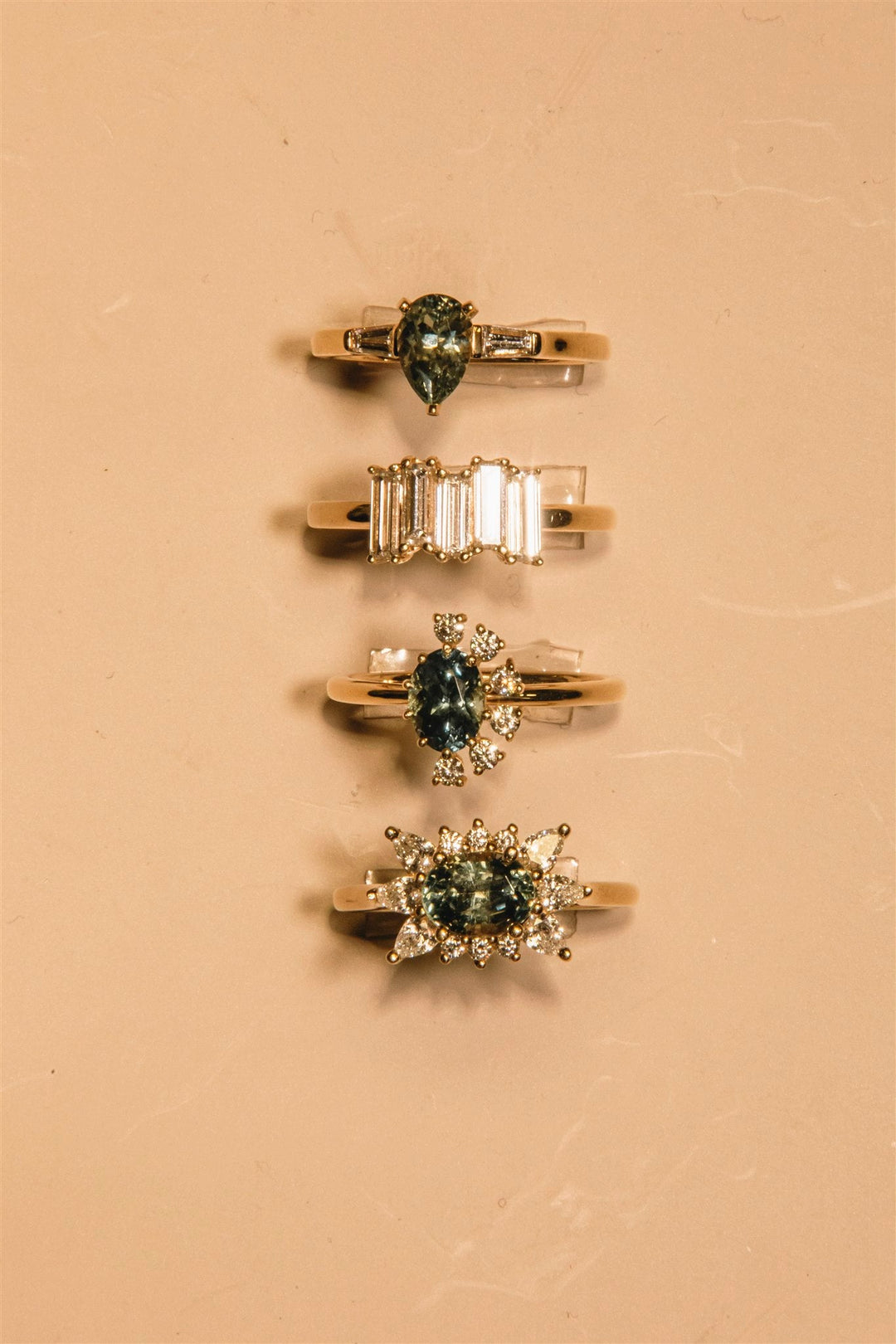
Cut. A significant share of fine Montana rough is precision-cut domestically, one stone at a time, oriented for color and light return rather than carat retention. The difference between a competent cut and a precise one is visible: light returned across the full face of the gem versus light held in dead zones.
Fine Montana sapphires — particularly untreated stones and top teals — have appreciated meaningfully as demand for traceable American gems has grown, and national attention is now reinforcing that trend. A Montana sapphire should still be purchased primarily as jewelry to be worn and kept, rather than as an investment.
How We Source Ours
There is a faster way to buy Montana sapphires than the one we use: call a dealer, accept a parcel, set what comes. We do not source that way, because the value of a Montana sapphire is in knowing where it came from. A vague supply chain discards the feature that matters.
What we require of every stone we accept:
- A named deposit. Rock Creek, Yogo, or Missouri River — not "Montana." Vagueness is information.
- Treatment status in writing. Heated or unheated, declared on the invoice. We disclose every stone we sell on the same basis.
- Cut quality. We favor precision-cut stones from American lapidaries who work one crystal at a time.
- Color that holds. A stone that reads the same across daylight and lamplight, and that earns the setting we will build for it.
What we decline matters as much as what we accept: any stone we cannot verify, any parcel sourced opaquely, and any description that substitutes evocative language for facts. Our work is built on what we can document.
Montana Sapphires as Talismans
A talisman is a physical object assigned to carry meaning — a decision, a passage, a milestone. The meaning is the wearer's. The object's role is to be permanent enough to hold it.
Humans have always selected the most durable materials available for the meanings that mattered most. Gold that does not tarnish. Stones that do not scratch. The material was the storage medium.
Montana sapphires are well-suited to that role. Corundum is among the most physically permanent substances a person can wear, and a Montana stone arrives with one additional feature most gemstones cannot offer: a verifiable origin in a specific landscape. For wearers who want a piece anchored to a real and knowable place, this matters.
Frequently Asked Questions
Are Montana sapphires real sapphires?
Yes. Montana sapphires are corundum, the same mineral as every other natural sapphire, and are gemologically identical to sapphires from any other source.
Are Montana sapphires more expensive than regular sapphires?
It depends on the stone. Fine Montana sapphires — particularly teals, parti-colored stones, untreated stones, and anything in fine color above one carat — command prices comparable to or above heated sapphires from classical sources. Top-tier untreated stones from historic origins still command the highest prices overall.
What is the rarest Montana sapphire color?
True 50/50 balanced teals and the warm tones — particularly fine pinks and saturated golden yellows — are the rarest production. Untreated stones of any color are rarer still.
Can Montana sapphires be used for engagement rings?
Yes. At 9 on the Mohs scale, sapphire is second only to diamond in hardness and is suited to daily lifetime wear.
What is the difference between a Yogo and a Montana sapphire?
A Yogo is a Montana sapphire from one specific deposit: Yogo Gulch in the Little Belt Mountains. Yogos are mined from a primary hard-rock deposit, are uniformly cornflower blue, naturally untreated, and almost always under one carat. The broader category of Montana sapphires usually refers to alluvial stones from Rock Creek and the Missouri River, which span a far wider color range.
How can I tell if a Montana sapphire is untreated?
Not by looking — gemological certainty requires lab testing. The practical answer is that the seller should provide treatment status in writing. Untreated Yogos are universally accepted as such. For Rock Creek and Missouri River stones, reputable sellers disclose treatment status on the invoice; significant stones sold as unheated should be backed by a report from an independent lab such as AGL or GIA.
The deposits these stones come from are small, seasonal, and located within one state. The mining is done by family operations. The supply chain is short and verifiable. We build with Montana sapphires because we live here and because we can document every step of how a stone reaches the bench.
If you are considering a Montana sapphire of your own, we recommend the slower approach: choose the stone first, build the piece around it, and wear the result for the rest of your life.
Explore our Montana sapphire collection →
Elizabeth Graham is the founder of Talismania, based in Red Lodge, Montana.